Sunday, September 30, 2012

I Stubbed My Piggy Toe!

Fractures (breaks) are common in the fifth metatarsal- the long bone on the outside of the foot that connects to the little toe. Two types of fractures that often occur in the fifth metatarsal are:
  • Avulsion fracture. In an avulsion fracture, a small piece of bone is pulled off the main portion of the bone by a tendon or ligament. This type of fracture is the result of an injury in which the ankle rolls. Avulsion fractures are often overlooked when they occur with an ankle sprain.
  • Jones fracture. Jones fractures occur in a small area of the fifth metatarsal that receives less blood and is therefore more prone to difficulties in healing. A Jones fracture can be either a stress fracture (a tiny hairline break that occurs over time) or an acute (sudden) break. Jones fractures are caused by overuse, repetitive stress, or trauma. They are less common and more difficult to treat than avulsion fractures.
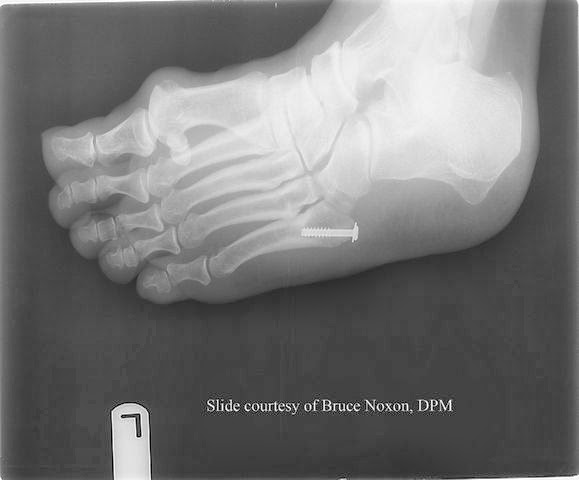
Other types of fractures can occur in the fifth metatarsal. Examples include mid-shaft fractures, which usually
result from trauma or twisting, and fractures of the fifth metatarsal head and neck.
Avulsion and Jones fractures have the same signs and symptoms. These include:
  • Pain, swelling, and tenderness on the outside of the foot.
  • Difficulty walking.
  • Bruising may occur.
Anyone who has symptoms of a fifth metatarsal fracture should see a podiatrist as soon as possible for proper diagnosis and treatment. To arrive at a diagnosis, the surgeon will ask how the injury occurred or when the pain started. The foot will be examined, with the doctor gently pressing on different areas of the foot to determine where there is pain.
The surgeon will also order x-rays. Because a Jones fracture sometimes does not show up on initial x-rays, additional imaging studies may be needed.
Until you are able to see a foot and ankle surgeon, the R.I.C.E. method of care should be performed:
Rest: Stay off the injured foot. Walking may cause further injury.
Ice: Apply an ice pack to the injured area, placing a thin towel between the ice and the skin. Use ice for 20
minutes and then wait at least 40 minutes before icing again.
Compression: An elastic wrap should be used to control swelling.
Elevation: The foot should be raised slightly above the level of your heart to reduce swelling.
The foot and ankle surgeon may use one of these non-surgical options for treatment of a fifth metatarsal fracture:
  • Immobilization. Depending on the severity of the injury, the foot is kept immobile with a cast, cast boot, or stiff-soled shoe. Crutches may also be needed to avoid placing weight on the injured foot.
  • Bone stimulation. A pain-free external device is used to speed the healing of some fractures. Bone stimulation, most commonly used for Jones fractures, may be used as part of the treatment or following an inadequate response to immobilization.
If the injury involves a displaced bone, multiple breaks, or has failed to adequately heal, surgery may be required. The foot and ankle surgeon will determine the type of procedure that is best suited to the individual patient.
If you believe you have a fracture in your fifth metatarsal and have not seen a podiatrist yet, call one of our six locations to make an appointment.
Connecticut Foot Care Centers
Podiatrists in CT
Visit our website, friend and like our page on Facebook, and follow our tweets on Twitter.

Enhanced by Zemanta

Thursday, September 27, 2012

Yard Clean-Up Can Be Hard On Feet

Fall is the time to clear out the remains of summer gardens from the yard. Keep your feet and ankles safe from injury by following these helpful tips:
  • Wear appropriate shoes for the task. No matter how warm it is, don't wear sandals. Wear sturdy leather shoes with support to protect your feet from sharp objects, including the blades of power equipment.
  • Keep your children away from power equipment. Protect your children and others from severe trauma. Leaf blowers, power lawn mowers, and chain saws should not be left out where kids are playing or where other inexperienced users can have access.
  • Don't work on wet surfaces. Ankle sprains and fractures can easily occur from slipping on wet grass or leaves, especially when carrying heavy loads across the yard.
  • Remember yard work is workout. Before starting your yard work, warm up and perform stretching exercises, just as you would before working out at the gym. By stretching prior to activity, you can help avoid stressing muscles and tendons in the foot, ankle, and calves.
If you have an foot accident while doing yard work, call one of our six locations to make an appointment.
Connecticut Foot Care Centers
Podiatrists in CT
Visit our website, friend and like our page on Facebook, and follow our tweets on Twitter.


Enhanced by Zemanta

Wednesday, September 26, 2012

One Directions' Zayn Malik Foot Injury Explained By Bieber

Zayn Malik spent a wild night out with Justin Bieber a couple of weeks ago and ended up needed crutches. The One Direction singer was hanging out at Justin's house after the MTV VMA show and both posted pictures to their Twitter profiles documenting their night, but neither mentioned a foot injury.
Fans wanted to know what happened to the popular boy band star when he appeared the next day at the airport on crutches. Zayn was keeping mum about how the injury occurred, reassuring fans on Twitter that he was okay: "Hey guys, just to let you know I'm all good, no need to worry... Just wanna take a moment to thank you guys for being so amazing. I've said it so many times but I'll say it again, you really are the best fans in the world... thank you so much for being incredible. Love you all."
Fortunately for fans, Bieber has no problem telling the story. Justin wasn't even at home when the incident happened, and says that Malik and friend Alfredo Flores were horsing around before Bieber got home. Malik apparently rolled his ankle on the half-pipe. A little more practice perhaps is needed?
If you are experiencing a foot problem, call one of our six locations to make an appointment.
Connecticut Foot Care Centers
Podiatrists in CT
Visit our website, friend and like our page on Facebook, and follow our tweets on Twitter.

Enhanced by Zemanta

Monday, September 24, 2012

My Ankle Hurts. Could I Have Fractured It?

A fracture is a partial or complete break in a bone. Fractures in the ankle can range from the less serious avulsion injuries (small pieces of bone that have been pulled off) to severe shattering-type breaks of the tibia, fibula, or both.
Ankle fractures are common injuries that are most often caused by the ankle rolling inward or outward. ankle fracture for an ankle sprain, but they are quite different and therefore require an accurate and early diagnosis. They sometimes occur simultaneously.
Many people mistake an
An ankle fracture is accompanied by one or all of these symptoms:
  • Pain at the site of the fracture, which in some cases can extended from the foot to the knee.
  • Significant swelling, which may occur along the length of the leg or may be more localized.
  • Blisters may occur over the fracture site. These should be promptly treated by a foot and ankle surgeon.
  • Bruising that develops soon after the injury.
  • Inability to walk- however, it is possible to walk with less severe breaks, so never rely on walking as a test of whether a bone has been fractured.
  • Change in the appearance of the ankle- it will look different from the other ankle.
  • Bone protruding through the skin- a sign that immediate care is needed. Fractures that pierce the skin require immediate attention because they can lead to severe infection and prolonged recovery.
Following an ankle injury, it is important to have the ankle evaluated by a foot and ankle surgeon for proper diagnosis and treatment. If you are unable to do so right away, go to the emergency room and then follow up with a foot and ankle surgeon as soon as possible for a more thorough assessment.
The affected limb will be examined by the foot and ankle surgeon by touching specific areas to evaluate the injury. In addition, the surgeon may order x-rays and other imaging studies, as necessary.
Treatment of ankle fractures depends upon the type and severity of the injury. At first, the foot and ankle surgeon will want you to follow the R.I.C.E. protocol:
  • Rest: Stay off the injured ankle. Walking may cause further injury.
  • Ice: Apply an ice pack to the injured area, placing a thin towel between the ice and the skin. Use ice for 20 minutes and then wait at least 40 minutes before icing again.
  • Compression: An elastic wrap should be used to control swelling.
  • Elevation: The ankle should be raised slightly above the level of your heart to reduce swelling.
Additional treatment options include:
  • Immobilization. Certain fractures are treated by protecting and restricting the ankle and foot in a cast or splint. This allows the bone to heal.
  • Prescription medications. To help relieve the pain, the surgeon may prescribe pain medications or anti-inflammatory drugs.
For some ankle fractures, surgery is needed to repair the fracture and other soft tissue related injuries, if present. The foot and ankle surgeon will select the procedure that is appropriate for your injury.
It is important to follow your surgeon's instructions after treatment. Failure to do so can lead to infection, deformity, arthritis, and chronic pain.
If you believe you have an ankle fracture and have not seen a podiatrist yet, call one of our six locations to make an appointment.
Connecticut Foot Care Centers
Podiatrists in CT
Visit our website, friend and like our page on Facebook, and follow our tweets on Twitter.

Enhanced by Zemanta

Friday, September 21, 2012

Hottest Shoes For Fall 2012

Happy fall! On this first day of autumn, we are ready to toss aside sandals and flip-flops for this fall's latest and greatest shoes. Hot on the runway for this season were classics with a twist. Here's our list of must have shoes:
1. Booties. If you're only going to buy one new pair of shoes this season, booties are your best bet- you can dress them up or down, and they look hot while still being practical.
2. Sexy pointy heels. This trend is probably inspired by the fashion of Mad Men (think sexy secretary!). These shoes are also perfect for work.
3. High heeled loafers. Ok, so not everyone is going to like this trend. Some comments have been that they look like granny shoes. But seriously, would granny wear a 2 inch heel and rock them with a pair of skinny jeans?
4. Snakeskin print. You don't have to purchase shoes that have real snakeskin; make the choice to go faux! They make an outfit seem cooler, go with just about anything, and there are a lot of options this season.
5. Preppy shoes. Feel studious and fashionable with classic shoes that are good in every season!
If you have a foot problem do not currently see a podiatrist, call one of our six locations to make an appointment.
Connecticut Foot Care Centers
Podiatrists in CT
Visit our website, friend and like our page on Facebook, and follow our tweets on Twitter.


Enhanced by Zemanta

Thursday, September 20, 2012

Vince Neil Continues Tour With Broken Foot

Despite the fact he has two broken bones in his foot, Motley Crue frontman Vince Neil is refusing to bail on his concert tour, insisting he'll play through the pain (which we don't recommend!).
Neil fractured two bones on his left foot while performing the band's finale at the Blossom Music Center last Wednesday night when extra steps were added to a stage exit production number and he wasn't told about the change. He tweeted a picture of his swollen foot before going to the doctor and said: "Cleveland tonight. Paramedics think I broke my foot. I hope not. Getting x-rays tomorrow in Toronto. Thanks Cleveland for understanding!"
Neil has since had the foot in a cast, but told TMZ nothing would keep him from the stage, even though he might have to tone down the physical stuff.
"Even though he's got two broken bones in his foot, he is performing for the rest of the tour. He is a trooper," said bandmate Nikki Sixx.
"The show must go on," said Neil. I thank my fans for their support and am sorry to disappoint them with a limited performance. I'm sorry it's impossible to give them the show they deserve."
If you believe you have a broken foot and have not seen a podiatrist, call one of our six locations to make an appointment.
Connecticut Foot Care Centers
Podiatrists in CT
Visit our website, friend and like our page on Facebook, and follow our tweets on Twitter.

Tuesday, September 18, 2012

Clicking and Clacking in the Ankle: Talar Dome Lesion

The ankle joint is composed of the bottom of the tibia (shin) bone and the top of the talus (ankle) bone. The top of the talus is dome-shaped and is completely covered with cartilage- a tough, rubbery tissue that enables the ankle to move smoothly. A talar dome lesion is an injury to the cartilage and underlying bone of the talus within the ankle joint. It is also called an osteochondral defect (OCD) or osteochondral lesion of the talus (OLT). Osteo means bone and chondral refers to cartilage.
Talar dome lesions are usually caused by an injury, such as an ankle sprain. If the cartilage doesn't heal properly following the injury, it softens and begins to break off. Sometimes a broken piece of the damaged cartilage and the bone will float in the ankle.
Unless the injury is extensive, it may take months, a year, or even longer for symptoms to develop. The signs and symptoms of a talar dome lesion may include:
  • Chronic pain deep in the ankle- typically worse when bearing weight on the foot (especially during sports) and less when resting.
  • An occasional clicking or clacking feeling in the ankle when walking.
  • A sensation of the ankle locking or giving out.
  • Episodes of swelling of the ankle- occurring when bearing weight and subsiding when at rest.
A talar dome lesion can be difficult to diagnose, because the precise site of the pain can be hard to pinpoint. To diagnose this injury, the foot and ankle surgeon will question the patient about recent or previous injury and will examine the foot and ankle, moving the ankle joint to help determine if there is pain, clicking, or limitation of motion within that joint.
Sometimes the podiatrist will inject the joint with an anesthetic (pain-relieving medication) to see if the pain goes away for a while, indicating that the pain is coming from inside the joint.
X-rays are taken, and often an MRI or other advanced imaging tests are ordered to further evaluate the lesion and extent of the injury.
Treatment depends on the severity of the talar dome lesion. If the lesion is stable (without loose pieces of cartilage or bone), one or more of the following non-surgical treatment options may be considered:
  • Immobilization. Depending on the type of injury, the leg may be placed in a cast or cast boot to protect the talus. During this period of immobilization, nonweightbearing range-of-motion exercises may be recommended.
  • Oral medications. Nonsteroidal anti-inflammatory drugs (NSAIDs), such as ibuprofen, may be helpful in reducing the pain and inflammation.
  • Physical therapy. Range-of-motion and strengthening exercises are beneficial once the lesion is adequately healed. Physical therapy may also include techniques to reduce pain and swelling.
  • Ankle brace. Wearing an ankle brace may be help protect the patient from re-injury if the ankle is unstable. 
If non-surgical treatment fails to relieve the symptoms of talar dome lesions, surgery may be necessary. Surgery may involve removal of the loose bone and cartilage fragments within joint and establishing an environment for healing. A variety of surgical techniques in available to accomplish this. The surgeon will select the best procedure based on the specific case.
Depending on the amount of damage to the cartilage in the ankle joint, arthritis may develop in the joint, resulting in chronic pain, swelling and limited joint motion. Treatment for these complications is best directed by a foot and ankle surgeon, and may include one or more of the following:
If you believe you have a talar dome lesion and do not currently see a podiatrist, call one of our six locations to make an appointment.
Connecticut Foot Care Centers
Podiatrists in CT
Visit our website, friend and like our page on Facebook, and follow our tweets on Twitter.
Enhanced by Zemanta